
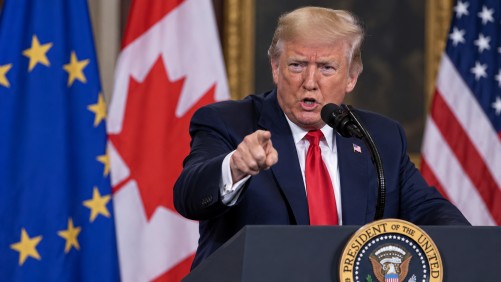
The proposal for Canada to become an associate member of the European Union could have significant economic ramifications, particularly if the United States follows through on its threat to impose tariffs on European goods. U.S. President Donald Trump has strongly criticized the EU’s initiative, labeling it “laughable” and cautioning that it might lead Washington to introduce “very serious tariffs” or reduce trade with the EU.
This development stems from European Commission President Ursula von der Leyen’s invitation to Canada to become the EU’s first “associate member.” The move is part of a broader strategy to enhance cooperation in key areas such as technology, defense, and energy. Von der Leyen emphasized the importance of strengthening ties between democracies in response to mounting challenges to the international rules-based system.
Canada’s potential associate membership would mark a significant expansion of its existing relationship with the EU, which already includes a trade agreement and several bilateral arrangements. The two entities have drawn closer since Trump’s return to the White House, particularly following his administration’s imposition of tariffs on traditional U.S. trading partners, including Canada and the EU.
In addition to seeking closer ties with the EU, Canada is looking to broaden its defense partnerships beyond its traditional alliance with the United States. Ottawa has applied to join the British-led Joint Expeditionary Force, a rapid-response military coalition comprising ten NATO member states.
The specifics of Canada’s proposed associate membership with the EU have not been finalized, as the EU currently lacks a formal category for such an arrangement. However, countries like Norway, Iceland, and Switzerland maintain close economic ties with the EU, hinting at possible frameworks for Canada’s inclusion. Von der Leyen has expressed a desire to forge a broader “alliance for the future” with Canada, focusing on sectors such as defense industries, artificial intelligence, critical minerals, batteries, cybersecurity, energy, and Arctic cooperation.