
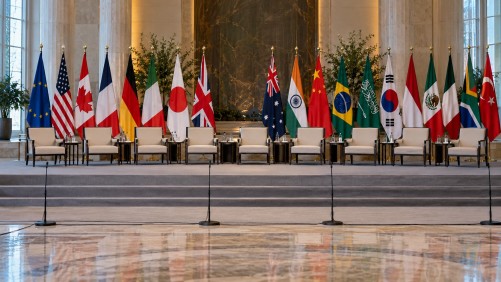
The United States has canceled the traditional group photograph at the G20 foreign ministers’ meeting in Atlanta, following objections from several countries, including the United Kingdom, Australia, and European Union members, who refused to participate if Russian Foreign Minister Sergei Lavrov was included. This decision reflects ongoing tensions over Russia’s role in the international community amid its conflict with Ukraine.
US Secretary of State Marco Rubio made the decision to cancel the photograph after it became clear that about one-third of the participating countries would boycott the event or walk out if Russian representatives were present. During the meeting’s opening, Rubio emphasized the need for unity in addressing global economic and geopolitical challenges, warning of interconnected crises impacting global security and trade.
European officials were particularly vocal in their opposition to including Lavrov in the photograph, with German Foreign Minister Johann Wadephul stating that there could be no semblance of normal relations with Russia given the current circumstances. UK Foreign Secretary Ed Miliband also confirmed Britain’s refusal to participate in a photograph that included Russian officials.
Australian Foreign Minister Penny Wong condemned Russia’s actions in Ukraine during the opening session, calling the war unjustified and highlighting its repercussions on international markets and global food security. Australia supported the US decision to cancel the photograph, reinforcing its stance against normalizing Russia’s actions.
The disagreement underscores persistent divisions within the G20 regarding Russia’s international role and complicates the Trump administration’s efforts to mend relations with Moscow despite the ongoing conflict in Ukraine. These divisions extend to other issues, such as Russia’s opposition to Poland’s potential G20 membership and South Africa’s exclusion from the invitation list, which has further strained relations.
Polish Deputy Prime Minister and Foreign Minister Radosław Sikorski acknowledged the challenges of reaching a consensus, citing disagreements among countries involved in ongoing conflicts. Meanwhile, South Africa’s absence, despite being a founding G20 member, has added to tensions with the United States following disagreements during South Africa’s G20 presidency in 2025.
These diplomatic rifts could impact preparations for the upcoming G20 leaders’ summit in Florida, which US President Donald Trump is set to host, as the likelihood of achieving a joint communique at the conclusion of the current meeting appears uncertain.